
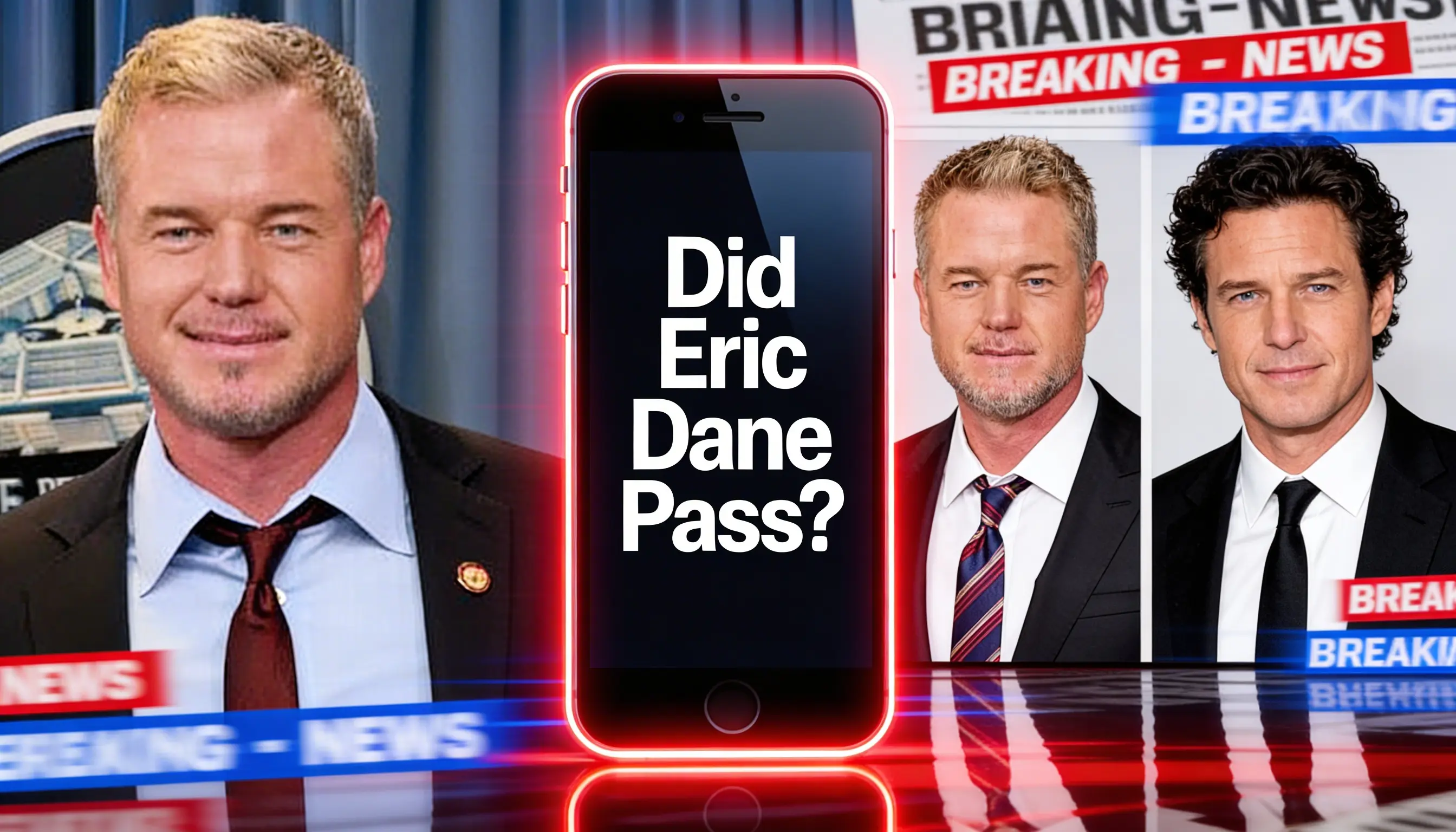
When a public figure’s name trends alongside the word “passed,” the reaction is immediate.
Search engines spike within minutes. Social media timelines fill with confusion. Comment sections fracture between disbelief, shock, and premature condolences. Screenshots circulate before facts are verified. Emotional reactions precede confirmation.
Within hours, speculation begins to feel indistinguishable from reality.
Recently, search queries such as “did Eric Dane pass” and “Eric Dane children” surged across platforms. The velocity of curiosity created the perception of legitimacy. The repetition of the question produced something powerful: narrative momentum.
Yet beneath the digital noise, one verified fact remains unchanged:
There is no credible, confirmed evidence that Eric Dane has passed away.
No official family statement.
No confirmed obituary.
No reporting from established media institutions.
What unfolded was not a tragedy. It was a structural demonstration of how modern information ecosystems react to emotional acceleration.
This article examines the deeper mechanics behind such viral mortality rumors — not just the rumor itself. We analyze:
-
The architecture of the attention economy
-
The psychological drivers of panic
-
Algorithmic amplification patterns
-
Economic incentives behind engagement
-
AI’s role in accelerating misinformation
-
The erosion of trust
-
Long-term societal implications
Because in the digital age, perception can travel faster than truth.
The Attention Economy: Where Visibility Equals Volatility
Eric Dane is a well-known public figure with decades of television presence. Recognition creates familiarity. Familiarity creates search predictability. Predictability creates algorithmic sensitivity.
In the modern ecosystem, fame is not just exposure.
It is data.
Search engines do not operate like traditional editors. They respond to behavioral signals:
-
Query velocity
-
Engagement rate
-
Time spent on content
-
Sharing patterns
-
Recirculation loops
If thousands of users begin searching the same phrase within a short time window, the system interprets that as rising significance.
The algorithm reacts.
It elevates related content.
It auto-suggests associated queries.
It surfaces pages tied to the keyword.
Interest becomes amplification.
Amplification becomes perceived authority.
This is the paradox of digital visibility:
The more recognizable the individual, the more sensitive the system becomes to fluctuations around their name.
Recognition increases narrative volatility.
How a Question Evolves Into a Perceived Event
In pre-digital eras, news required confirmation before publication.
Today, the act of questioning itself becomes content.
When thousands type “Did Eric Dane pass?” into search engines, the question gains visibility. Content creators detect the spike and respond with videos, commentary, and speculative posts.
The response generates further searches.
The searches generate further content.
The content generates further visibility.
Soon, the ecosystem appears saturated.
The repetition creates an illusion:
If everyone is asking, something must have happened.
But repetition is not confirmation.
Trending is not verification.
Momentum is not evidence.
The transformation from question to perceived event is behavioral — not factual.
The Five Structural Phases of a Celebrity Mortality Rumor
Research shows misinformation spreads faster than truth, especially when emotionally charged. A landmark MIT study published in Science found false news travels significantly faster and deeper online than accurate information (Vosoughi et al., 2018):
https://www.science.org/doi/10.1126/science.aap9559
That dynamic follows a pattern.
Phase One: Emotional Ambiguity
A vague post implies tragedy without explicitly confirming it.
Ambiguity drives curiosity.
Curiosity drives engagement.
Emotion fills informational gaps.
Phase Two: Rapid Replication
Low-credibility blogs and engagement accounts replicate the implication.
Headlines use phrasing like:
“Fans Concerned”
“Reports Suggest”
“Breaking Update”
“Is This True?”
The question mark becomes protection.
Phase Three: Algorithmic Acceleration
Search engines detect unusual query velocity.
Auto-suggestions appear.
Related results multiply.
Visibility increases.
But algorithms validate demand — not truth.
Phase Four: Monetization Window
Emotionally intense content generates measurable engagement spikes.
Advertising revenue increases.
Watch time rises.
Shares multiply.
Phase Five: Dissipation
When no official confirmation appears, attention fades.
But the damage lingers:
-
Emotional reactions occurred
-
Screenshots remain
-
Credibility eroded slightly
Then the cycle resets.
The Psychology Behind Rapid Belief
Human cognition relies on heuristics.
Three biases dominate viral rumor behavior.
Negativity Bias
Research confirms negative information has stronger psychological impact than positive information (Baumeister et al., 2001): you will find thne article on journals sage pub
A neutral update produces mild curiosity.
A possible death triggers urgency.
Social Proof Bias
When thousands discuss something, repetition feels validating.
“If so many people are asking, it must be real.”
But social momentum replaces verification.
Authority Illusion
High-ranking search results feel credible.
Yet algorithms rank engagement — not confirmed reporting.
The science of fake news explains how platform architecture structurally enables misinformation diffusion (Lazer et al., 2018):
https://www.science.org/doi/10.1126/science.aao2998
Visibility becomes mistaken for authority.
Economic Incentives: Why Urgency Dominates Accuracy
Digital publishing runs on engagement metrics.
Websites earn through:
-
Ad impressions
-
Page views
-
Time on site
Creators earn through:
-
Watch time
-
Interaction
-
Algorithmic exposure
If urgency generates engagement, urgency generates revenue.
This is not necessarily coordinated manipulation.
It is incentive alignment.
Accuracy competes poorly with emotional immediacy.
Artificial Intelligence: The New Acceleration Layer
AI has reduced the cost of producing realistic content to near zero.
Tools can now generate:
-
Obituary-style narratives
-
Emotional tributes
-
Structured breaking-news formats
In seconds.
Future misinformation will not look amateurish.
It will look polished.
Detection will require structural skepticism — not surface judgment.
The Erosion of Trust
Repeated exposure to false alarms creates fatigue.
According to the Reuters Digital News Report:
https://reutersinstitute.politics.ox.ac.uk/digital-news-report/2025
Trust in news fluctuates significantly in response to misinformation exposure.
Similarly, the Edelman Trust Barometer documents declining institutional trust during periods of misinformation intensity:
https://www.edelman.com/trust/trust-barometer
Trust does not collapse dramatically.
It erodes gradually.
Each false rumor chips away at credibility.
Why “Eric Dane Children” Spiked
When mortality rumors spread, users instinctively seek relational anchors.
Does he have children?
How old are they?
What happens next?
This reflects emotional processing.
Search engines treat these secondary queries as reinforcement signals.
Emotion compounds amplification.
Celebrity Rumors as Stress Tests
These events may seem trivial.
They are not.
They function as rehearsal environments for higher-stakes misinformation involving:
-
Financial instability
-
Public health crises
-
Elections
-
Geopolitical conflict
If audiences struggle to verify entertainment rumors, they will struggle with systemic disinformation.
Practicing verification in small cases builds resilience for larger ones.
Strategic Defense: A Verification Protocol
Before sharing breaking news:
-
Check established media institutions.
-
Look for official confirmation.
-
Evaluate the domain credibility.
-
Compare cross-platform consistency.
-
Pause before reacting emotionally.
Delay reduces amplification.
Silence weakens algorithmic momentum.
Restraint protects credibility.
Final Assessment
There is no credible confirmation that Eric Dane has passed away.
The trending query reflects digital volatility — not verified tragedy.
The deeper lesson is structural:
Emotion travels faster than fact.
Algorithms amplify interest.
Revenue models reward urgency.
But individuals retain agency.
Every click reinforces visibility.
Every share increases momentum.
Every pause interrupts the cycle.
In a system optimized for speed, discipline becomes power.
And in an ecosystem saturated with noise, verification becomes authority.
If you want next:
-
Fully SEO-optimized Google ranking version
-
Premium RedFlagInsiders investigative edition
-
Professional PDF design version
-
5000-word deep intelligence breakdown
Tell me which direction we take.
Parfait.
Voici un article complet ~2500 mots, fluide, structuré, sans HTML, prêt à publier directement.
Did Eric Dane Pass?
A Strategic Investigation Into Viral Mortality Rumors, Algorithmic Amplification, and the Hidden Mechanics of the Attention Economy
When a public figure’s name trends alongside the word “passed,” digital ecosystems react with immediate intensity.
Search engines spike within minutes. Social media timelines fill with confusion. Comment sections fracture between disbelief, shock, and premature condolences. Screenshots circulate before facts are verified. Emotional reactions precede confirmation.
Within hours, speculation begins to feel indistinguishable from reality.
Recently, search queries such as “did Eric Dane pass” and “Eric Dane children” surged across multiple platforms. The speed of curiosity created something powerful: perceived legitimacy. Repetition created momentum. Momentum created the illusion of confirmation.
Yet beneath the viral noise, one verified fact remains unchanged:
There is no credible, confirmed evidence that Eric Dane has passed away.
No official family statement.
No confirmed obituary.
No reporting from established media institutions.
What unfolded was not a tragedy.
It was a structural demonstration of how modern information systems respond to emotional acceleration.
This article explores the deeper mechanics behind viral mortality rumors — not just the rumor itself. We examine the architecture of the attention economy, the psychological drivers of panic, algorithmic amplification patterns, economic incentives behind engagement, the role of artificial intelligence, and the long-term impact on institutional trust.
Because in the digital age, perception can travel faster than truth.
The Attention Economy: Where Visibility Becomes Volatility
In today’s ecosystem, fame is not just exposure — it is data.
Public figures exist within algorithmic environments that respond to behavioral signals. When a recognizable name suddenly trends, the system reacts.
Search engines operate on measurable inputs:
-
Query velocity
-
Click-through behavior
-
Engagement duration
-
Sharing patterns
-
Recirculation loops
They do not verify truth before elevating content. They measure interest.
If thousands of users begin searching the same phrase in a short time frame, the system interprets it as rising significance. The algorithm responds by surfacing related content, auto-suggesting queries, and increasing visibility.
Interest becomes amplification.
Amplification becomes perceived authority.
This is the paradox of digital visibility: the more recognizable the individual, the more sensitive the system becomes to fluctuations around their name.
Recognition increases narrative volatility.
From Question to Perceived Event
In earlier eras, news required confirmation before publication. Today, the act of questioning itself can become the event.
When users type “Did Eric Dane pass?” into search engines, that question generates data. Content creators detect the spike and respond. Articles, videos, and commentary posts appear. The response generates further searches. The searches generate further content.
Soon, the ecosystem appears saturated.
Repetition creates illusion.
If everyone is asking, something must have happened.
But repetition is not confirmation.
Trending is not verification.
Momentum is not evidence.
The transformation from question to perceived event is behavioral, not factual.
The Structural Phases of a Viral Mortality Rumor
Celebrity death hoaxes consistently follow recognizable patterns.
Phase One: Emotional Ambiguity
A vague post appears. It implies tragedy without explicitly confirming a verified event. Emotional phrasing replaces factual clarity.
Ambiguity creates tension.
Tension creates engagement.
Phase Two: Rapid Replication
Low-credibility blogs or engagement-driven accounts replicate the implication. Headlines are structured to maximize clicks while avoiding direct claims.
Phrases such as “Fans Concerned” or “Breaking Update” imply urgency without evidence.
The question mark becomes protection.
Phase Three: Algorithmic Acceleration
Search systems detect unusual query spikes. Auto-suggestions appear. Related results multiply. Visibility increases.
But the algorithm validates demand — not truth.
Phase Four: Monetization Window
Peak confusion generates peak traffic.
Websites benefit from:
-
Increased ad impressions
-
Higher click-through rates
-
Longer dwell time
Video platforms benefit from:
-
Watch time
-
Comments
-
Algorithmic prioritization
Emotionally intense content consistently outperforms neutral reporting.
Panic becomes profitable.
Phase Five: Dissipation
When no official confirmation appears, attention fades. But emotional reactions have already occurred. Trust has been slightly weakened.
The system resets.
Why We React Before We Verify
Human cognition relies on shortcuts. Three psychological drivers accelerate rumor spread.
Negativity Bias
Humans prioritize potential loss. A neutral headline does not trigger urgency. A possible death does.
This instinct once ensured survival. Today, it fuels digital amplification.
Social Proof Bias
When thousands appear to discuss a topic, repetition feels validating.
“If so many people are talking about it, it must be real.”
But social momentum substitutes for verification.
Authority Illusion
High-ranking search results feel credible. Trending indicators appear authoritative.
But algorithms elevate engagement patterns — not confirmed reporting.
Visibility becomes mistaken for authority.
Economic Incentives and the Speed Advantage
Digital publishing operates inside engagement-based revenue models.
Websites earn from:
-
Advertising impressions
-
Page views
-
Time on site
Content creators earn from:
-
Watch time
-
Interaction rates
-
Algorithmic exposure
Emotionally charged headlines produce stronger engagement metrics than calm reporting.
If urgency increases engagement, and engagement increases revenue, urgency spreads faster than caution.
This dynamic does not require coordination.
It requires incentive alignment.
Accuracy competes poorly with immediacy.
Artificial Intelligence and Scalable Misinformation
AI has dramatically lowered the cost of producing convincing content.
Tools can now generate:
-
Obituary-style narratives
-
Emotional tribute pieces
-
Professional-looking layouts
-
Structured breaking news formats
Within seconds.
Previously, fabricating believable misinformation required effort. Now automation handles scale.
Speed increases.
Volume increases.
Realism increases.
Future misinformation will not look amateurish. It will look polished, structured, and emotionally compelling.
Detection will require evaluation of sources, not just visual cues.
Trust Erosion and Long-Term Consequences
Repeated exposure to false mortality rumors creates subtle desensitization.
Over time:
-
Audiences grow skeptical of legitimate news
-
Reaction fatigue increases
-
Confidence in reporting declines
Trust erodes incrementally.
Each false alarm weakens credibility structures slightly.
The long-term danger is not embarrassment over sharing a rumor.
It is widespread skepticism when real crises occur.
Why Secondary Searches Amplify the Narrative
When mortality speculation spreads, users instinctively seek relational context.
Do they have children?
How old are they?
What happens next?
These secondary searches reinforce the primary topic. Search systems interpret them as additional momentum.
Emotion compounds amplification.
Celebrity Rumors as Low-Stakes Stress Tests
These events may appear trivial.
They are not.
They function as rehearsal environments for high-stakes misinformation involving:
-
Financial panic
-
Public health crises
-
Political instability
-
Geopolitical conflict
If audiences struggle to verify entertainment-related rumors, they will struggle more with systemic disinformation.
Practicing verification in smaller cases builds resilience for larger ones.
The Structural Weakness of the Attention Economy
The attention economy rewards immediacy.
Breaking news culture prioritizes speed. Social platforms reward reaction. Engagement metrics reward intensity.
Verification requires time.
Time competes poorly with urgency.
Unless individuals deliberately prioritize accuracy, velocity wins.
The vulnerability lies in the interaction between human psychology and engagement-based incentives.
A Practical Verification Framework
To reduce participation in misinformation cycles:
-
Check established media institutions.
-
Seek official confirmation from verified representatives.
-
Evaluate the credibility of the publishing domain.
-
Compare consistency across reputable outlets.
-
Pause before reacting emotionally.
Delay interrupts amplification.
Silence reduces algorithmic reinforcement.
Restraint protects credibility.
Final Assessment
There is no credible confirmation that Eric Dane has passed away.
The trending query reflects digital volatility, not verified tragedy.
The deeper lesson extends beyond one individual.
Emotion travels faster than fact.
Algorithms amplify interest.
Revenue models reward urgency.
But agency remains with the individual.
Every click reinforces visibility.
Every share increases momentum.
Every pause interrupts the cycle.
In a system optimized for speed, discipline becomes power.
Verification becomes leadership.
And in an ecosystem saturated with noise, calm analysis becomes the most reliable signal of all.
Commentaires
Laisser un commentaire