
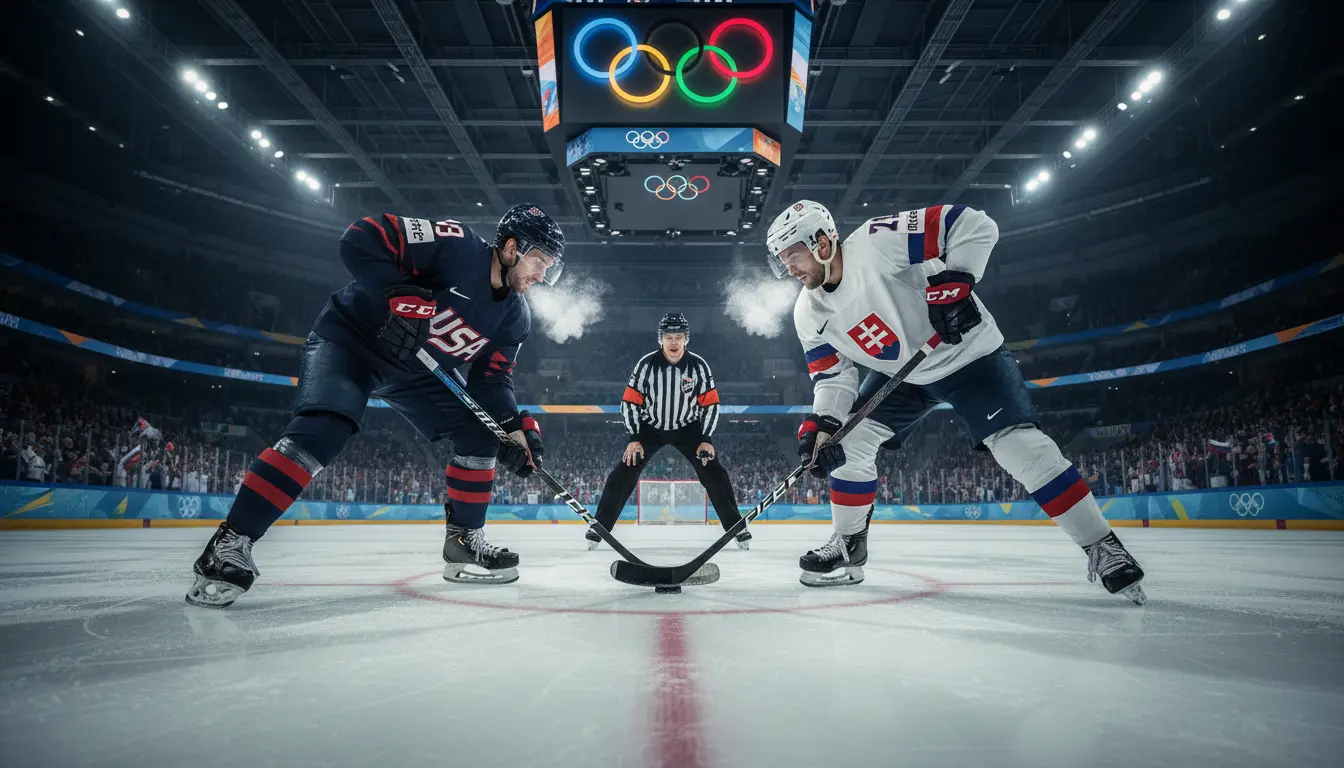
Olympic hockey is never just about hockey.When the United States faces Slovakia on the Olympic stage, the scoreboard tells one story. The systems behind the scoreboard tell another.At first glance, USA vs Slovakia appears straightforward: a global sports superpower versus a disciplined mid-tier hockey nation. A deep NHL-powered roster versus a compact, structured European system. Speed versus resistance.But if we stop at the surface, we miss the real story.Because in Olympic hockey, dominance can mask vulnerability.And vulnerability — if ignored — becomes a red flag.This is not simply a breakdown of a semifinal.
This is a strategic audit of two hockey models colliding under maximum pressure.
The Illusion of Control: When Dominance Becomes Complacency
Team USA hockey entered the Olympic tournament with structural advantages:
-
A massive development pipeline
-
Elite NHL participation
-
Sports science infrastructure
-
Commercial leverage
-
Media dominance
On paper, the Team USA hockey roster looks engineered for inevitability.But Olympic tournaments have a dangerous characteristic:
They punish overconfidence faster than any other format.When the United States builds a 5-0 lead against Slovakia, analysts praise offensive depth. Commentators celebrate transition speed. USA men’s hockey scores trend across social media.Yet beneath that dominance, professionals look for something else:
Is the structure sustainable?
Is the system disciplined under success?
Or is it accelerating beyond control?
Red Flag Insight #1:
Speed without containment eventually creates exposure.
The Structural Gap: Scale vs Efficiency
USA hockey is built on scale.Thousands of youth programs.Elite national development academies.NCAA integration.NHL synergy.Slovakia hockey is built on efficiency.Smaller pool.Export-driven talent.Tactical cohesion.Compact defensive identity.When USA vs Slovakia unfolds, the contrast becomes visible immediately.USA stretches the ice.Slovakia compresses it.USA activates defensemen aggressively.Slovakia waits for counterattacks.One model expands.One model constrains.Both can win.But only one survives pressure consistently.
Red Flag #2: Offensive Activation Risk
Modern USA hockey encourages defensemen to become offensive catalysts.Players like Zach Werenski represent this evolution: mobile, confident, capable of quarterbacking power plays and initiating breakouts.The benefit: numerical advantage in the offensive zone.The risk: transition vulnerability.Against Slovakia, that risk may not always materialize.Against Canada or a structurally elite opponent, it might.The red flag is not activation itself.The red flag is activation without disciplined recovery lanes.Olympic hockey exposes this ruthlessly.
Psychological Exposure: The Weight of Expectation
USA men’s hockey does not play in silence.Every USA hockey game today carries:
-
Media amplification
-
Digital dissection
-
National expectation
-
Sponsor visibility
Slovakia plays under a different psychological architecture.
Less scrutiny.
Less noise.
Less entitlement.
In pressure scenarios, psychological load becomes decisive.
Red Flag #3:
Expectation accelerates emotional volatility.
If USA concedes first, urgency spikes.If Slovakia concedes first, structure remains.Underdog freedom is a competitive weapon.
The Efficiency Model: What Slovakia Gets Right
Slovakia hockey is often underestimated because it lacks depth on paper.But structure compensates for scale.
Key tactical strengths:
-
Layered neutral zone resistance
-
Shot lane discipline
-
Rebound containment
-
Low penalty tolerance
Slovakia’s model minimizes chaos.And in Olympic tournaments, chaos kills favorites.When Slovakia reached the semifinals, it wasn’t accidental. It was systemic.
Red Flag #4 for USA:
Volume dominance does not guarantee efficiency dominance.
Data Behind the Tournament: What Actually Predicts Olympic Success?
Historical Olympic hockey data reveals patterns:
-
Teams with lower penalty minutes advance deeper.
-
Save percentages above .920 in elimination rounds correlate with medal appearances.
-
Balanced scoring distribution reduces predictability.
-
Defensive zone clearance efficiency determines late-game stability.
USA often dominates possession metrics.Slovakia often excels in defensive containment metrics.The question is not who controls the puck.The question is who controls risk.
Special Teams: The Hidden Leverage Layer
Olympic tournaments are frequently decided on special teams USA’s power play relies on:
-
Perimeter puck movement
-
Blue-line shooting
-
Net-front screens
Slovakia’s penalty kill relies on:
-
Shot blocking discipline
-
Lane compression
-
Aggressive clearances
Red Flag #5:
Predictability reduces elite power play efficiency.
If USA becomes pattern-based, structured teams adapt quickly Championship-level teams vary attack points.
Goaltending Volatility: The Single Most Dangerous Variable
No Olympic analysis is complete without addressing goaltending variance.A hot goalie can erase structural superiority.A soft goal can destabilize momentum.USA typically fields NHL-caliber goaltenders accustomed to pressure environments.Slovakia often depends on technically precise, positionally disciplined netminders.In compressed tournaments, one period defines trajectory.
Red Flag #6:
Reliance on shot volume can mask declining shot quality.
High quantity does not equal high danger.
System Sustainability: Can USA Maintain Balance?
The American development model is undeniably powerful.But sustainability requires recalibration.Key structural risks include:
-
Overactivation from defense
-
Emotional penalties under scoreboard stress
-
Top-line dependency
-
Fatigue from high-tempo systems
If USA hockey does not integrate patience into its aggression, long-term Olympic dominance becomes volatile.
Dominance must be sustainable — not explosive.
The Slovakia Blueprint: A Model for Efficient Growth
Slovakia’s trajectory reveals something deeper You do not need scale to compete.
You need:
-
Identity clarity
-
Tactical discipline
-
International exposure
-
Development cohesion
Slovakia hockey proves that structure can neutralize disparity And that is strategically disruptive.
Commercial Pressure vs Structural Integrity
USA hockey exists inside a massive commercial ecosystem Olympic performance influences:
-
Youth registration
-
Sponsorship contracts
-
Broadcast leverage
-
Brand positioning
Commercial pressure can accelerate expectations.
Red Flag #7:
When commercial urgency exceeds tactical patience, execution declines.
Slovakia, with less commercial burden, maintains cleaner tactical focus.
Scenario Risk Mapping
Let’s examine three structural outcomes in USA vs Slovakia matchups.
Scenario 1: USA Scores Early
Advantage expands Slovakia opens structure Depth becomes decisive Low risk.
Scenario 2: Slovakia Scores First
Urgency increases for USA Defensive activation escalates.Odd-man rush risk rises Medium risk.
Scenario 3: Defensive Stalemate Late in Game
Penalty discipline decides outcome Goaltending variance magnifies Psychological control dominates High risk for the favorite Olympic hockey often rewards Scenario 3 specialists.
The Deeper Lesson: Hockey as a Strategic Mirror
USA vs Slovakia is not just sport.It is a mirror of two strategic philosophies:
Expansion vs Containment.
Scale vs Efficiency.
Expectation vs Freedom.
The winner is not necessarily the deeper roster.The winner is the system that aligns aggression with discipline.
The Constructive Path Forward
For USA Hockey:
-
Reinforce defensive recovery discipline
-
Diversify power play patterns
-
Integrate emotional resilience training
-
Balance tempo with situational control
For Slovakia Hockey:
-
Expand depth scoring capacity
-
Maintain structural identity
-
Invest in youth pipeline scalability
-
Continue international league integration
Constructive journalism does not merely expose risk It offers direction.
The Strategic Conclusion
USA vs Slovakia at the Olympic Games is not about five goals or a single semifinal It is about structural credibility USA hockey embodies development power and acceleration Slovakia hockey embodies discipline and efficiency Red flags do not announce themselves loudly They appear quietly inside success.
If USA hockey assumes dominance equals invulnerability, volatility increases.If Slovakia continues refining structure while expanding depth, disruption potential rises.Olympic hockey punishes arrogance.It rewards alignment.Speed without containment creates exposure.Structure without initiative limits breakthrough.
Balance defines sustainable dominance.
And in the unforgiving spotlight of Olympic competition, the nation that best synchronizes preparation, psychology, discipline, and execution will not only win medals —
It will define the future credibility of its entire hockey system.In elite competition, victory can be deceptive. A commanding scoreline may suggest dominance, but strategic credibility is not built on single performances — it is built on structural consistency under evolving pressure. The USA vs Slovakia Olympic clash reminds us that systems must be stress-tested not only when trailing, but especially when leading. Because success often hides weaknesses that only disciplined analysis can reveal. The true question is not whether Team USA can overwhelm — it is whether it can sustain balance when confronted by equally structured resistance.
For Slovakia, the semifinal stage signals something equally significant: efficient systems can challenge scale. Tactical clarity, disciplined spacing, and psychological composure remain competitive equalizers in a sport increasingly defined by speed and resources. Olympic hockey is not just a tournament; it is a diagnostic tool for national programs. And in that diagnostic moment, both USA and Slovakia reveal a deeper truth — sustainable dominance belongs not to the fastest system, but to the most aligned one.
Commentaires
Laisser un commentaire