
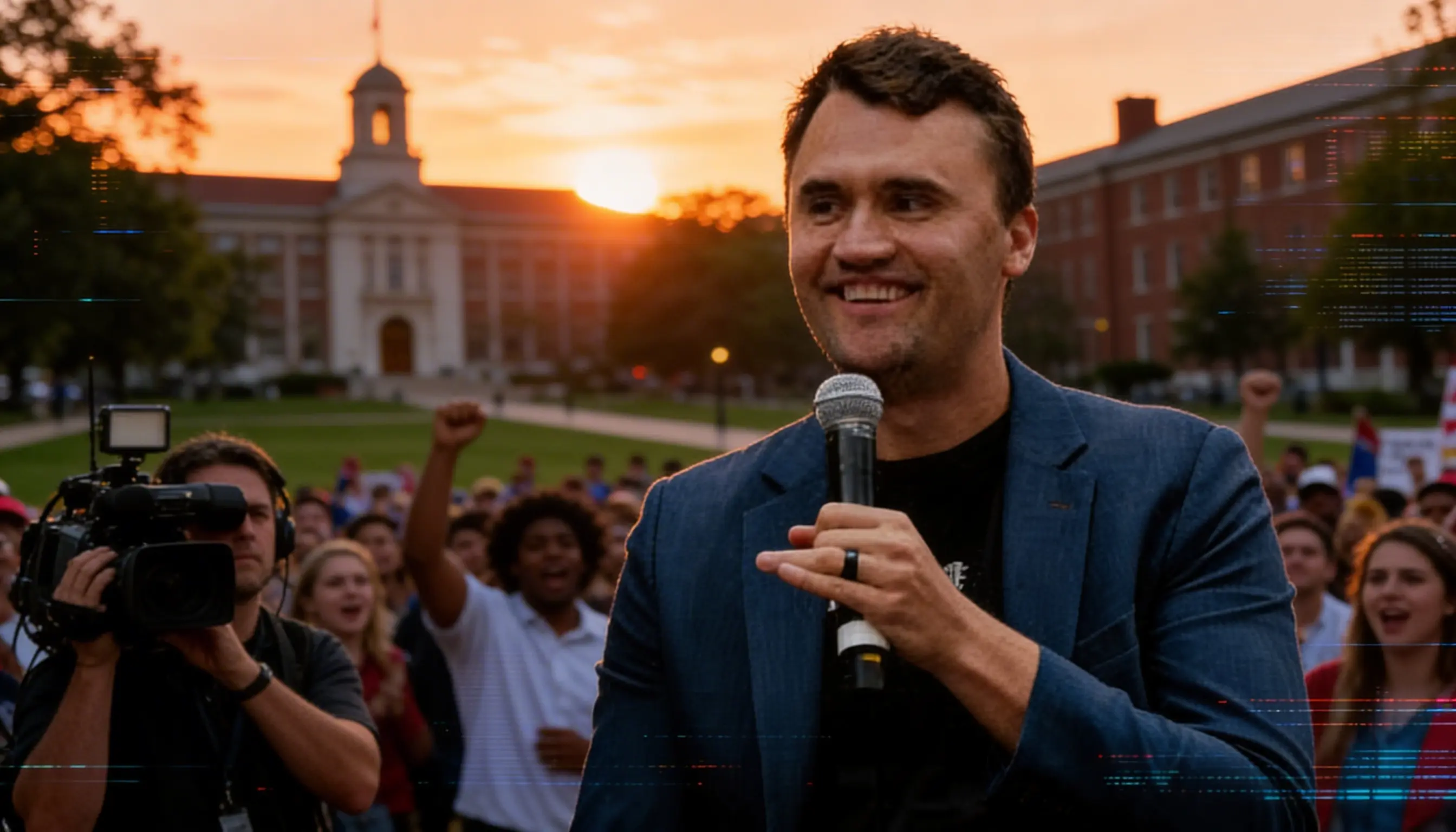
A New Political Power Model
Political influence in the 21st century no longer follows the traditional pathway of party apprenticeship, think tank scholarship, or slow institutional advancement. Instead, it increasingly emerges from media fluency, brand positioning, donor alignment, and algorithmic amplification. Charlie Kirk stands as one of the clearest examples of this structural transformation.
To some, he is a champion of conservative youth engagement. To others, he represents ideological polarization on college campuses. But beyond praise or criticism lies a more important analytical question:
How did a young activist build a national political infrastructure that competes with long-established institutions?
Understanding that question requires looking beyond headlines and viral clips. It requires examining systems — funding systems, media systems, recruitment systems, and influence systems.This is not a partisan evaluation. It is a structural investigation into how modern youth political movements scale, consolidate power, and sustain relevance.
The Founding Moment and Strategic Timing
Charlie Kirk founded Turning Point USA in 2012, at a time when American politics was already entering a period of intense polarization. Social media platforms were maturing. Smartphones were becoming universal. Political identity was increasingly expressed online.
The timing mattered.
Young conservatives on many campuses felt ideologically outnumbered. There was a perceived vacuum — an opportunity to build a counterweight within academic environments widely viewed as left-leaning.
Rather than attempting to reform institutions from within, Turning Point USA focused on parallel construction:
- Create alternative campus networks
- Offer students a recognizable ideological community
- Supply branded materials and structured messaging
- Build national events that reinforce belonging
From the beginning, this was not random activism. It was strategic positioning within a cultural landscape already primed for ideological consolidation.
Organizational Structure: A Franchise Model of Activism
Turning Point USA’s campus chapter model resembles a business expansion strategy more than an organic grassroots movement.
Key components include:
- Centralized branding
- Standardized messaging guides
- Organized training conferences
- Paid field representatives
- Student ambassador programs
This model provides scalability. Chapters can expand rapidly while maintaining message consistency. Organizational discipline reduces fragmentation.
In business terms, it is brand-controlled decentralization.
The benefit: speed of growth and clarity of identity.
The risk: reduced internal ideological diversity.
When activism becomes systematized, it gains efficiency — but it may lose spontaneity.
1. Funding Architecture and Financial Scale.
Recent years have seen Turning Point USA generate tens of millions of dollars in revenue each year, according to public nonprofit filings. These funds support:
• Staff salaries.
• National conferences.
• Media production teams.
• Campus outreach programs.
• Political advocacy initiatives.
Financial backing allows professionalization. The organization finances travel, digital marketing, merchandise production, and event logistics.
However, financial stability involves structural considerations: Who are the primary donors?
2. How aligned is messaging with donor priorities?
3. How transparent are financial operations?
Political nonprofits across the ideological spectrum operate within donor ecosystems. However, youth-focused organizations occupy a unique space. They are shaping first-time voters, forming long-term ideological identities, and influencing future leadership pipelines.
When large-scale funding intersects with youth political formation, scrutiny becomes essential — not as accusation, but as democratic due diligence.
The Digital Media Engine
Charlie Kirk’s influence is inseparable from his digital presence. His social media strategy relies heavily on:
- Short-form debate clips
- Campus confrontation videos
- Rapid-response commentary
- Highly shareable soundbites
This format is optimized for algorithms.
Platforms reward:
- Clear binary framing
- Emotional intensity
- Visual confrontation
- Audience participation
Long-form policy nuance rarely trends. Direct, emotionally charged exchanges do.
The digital environment reshapes political incentives. Leaders become content creators. Debates become performance events. Engagement metrics become strategic indicators.
The question is not whether this model works — it demonstrably does.
The question is whether algorithmic reward structures distort public discourse.
The Psychology of Youth Political Identity
Modern political mobilization increasingly resembles consumer brand development.
Young supporters are not merely voters. They are community members within an identity ecosystem.
Key psychological drivers include:
- Belonging
- Recognition
- Ideological clarity
- Social validation
- Collective purpose
Turning Point USA’s large conferences function as reinforcement mechanisms. Thousands gather, hear keynote speeches, engage with influencers, and share content online. The experience deepens loyalty.
Political identity becomes experiential.
And experience strengthens retention.
Campus as Recruitment Infrastructure
Universities are high-density environments for political recruitment:
- Large populations of first-time voters
- Exposure to diverse viewpoints
- High social connectivity
- Media-active student populations
For any political movement, campuses represent a long-term investment opportunity.
By embedding structured chapters, hosting debates, and distributing branded materials, Turning Point USA transforms campuses into recruitment hubs.
The strategic brilliance lies in timing. Capture ideological identity early, and it often persists for decades.
This is not unique to conservative movements. Progressive organizations apply similar strategies.
The difference lies in scale, funding, and media integration.
Media Bypass and Institutional Tension
Charlie Kirk frequently criticizes mainstream media institutions. His strategy largely bypasses them.
Instead of relying on legacy gatekeepers, he speaks directly to his audience through podcasts, social platforms, and event livestreams.
This direct channel offers advantages:
- Narrative control
- Immediate audience feedback
- Reduced editorial filtering
- High loyalty engagement
However, bypassing traditional journalism also reduces friction. Fewer gatekeepers means fewer fact-checking layers.
The broader media environment becomes fragmented into parallel ecosystems.
Each ecosystem reinforces its own narratives.
Polarization intensifies not only because of ideology — but because audiences inhabit different informational realities.
Influence and the Monetization Layer
While Turning Point USA operates as a nonprofit, the broader ecosystem includes monetizable elements:
- Branded merchandise
- Sponsored events
- Media partnerships
- Conference ticket sales
- Donor fundraising cycles
Political movements increasingly resemble hybrid entities: part advocacy group, part media brand, part event production company.
Sustainability requires revenue.
Revenue requires engagement.
Engagement favors intensity.
This feedback loop shapes content strategy.
Structural Red Flags
An investigative lens highlights several structural risk signals:
• High donor concentration influencing youth messaging
• Algorithm-driven content prioritizing confrontation
• Personality-centric leadership concentration
• Limited internal dissent visibility
• Political identity framed as binary opposition
These are not accusations. They are systemic patterns common to many modern movements.
Awareness enables accountability.
The Broader Global Pattern
Charlie Kirk’s influence model is part of a global shift in political communication.
Across continents, political entrepreneurs:
- Build youth-oriented nonprofits
- Leverage social media virality
- Host mass rallies for brand reinforcement
- Convert digital engagement into offline mobilization
Political branding has merged with marketing science.
Campaign tactics once reserved for election seasons now operate year-round.
Movements no longer wait for election cycles. They maintain continuous digital presence.
Long-Term Democratic Implications
Several long-term considerations emerge:
1. Institutional Competition
Nonprofit youth movements compete with traditional civic education systems.
2. Acceleration of Polarization
Algorithmic incentives amplify extremes over moderation.
3. Professionalization of Youth Activism
Paid staff and centralized messaging reduce unpredictability.
- Leadership Pipeline Engineering
Campus recruitment creates future political candidates and operatives.
Democracy benefits from engagement. But it also depends on informed, critical participation.
Balancing mobilization with deliberation becomes the central challenge.
Future Outlook
The next decade may see:
- Increased regulatory scrutiny of nonprofit funding
- Greater transparency requirements
- Platform algorithm reforms
- Fragmentation into micro-influencer ecosystems
- Expansion into new media formats
Youth political mobilization will not decline. It will evolve.
Movements that adapt to emerging technologies — including AI-driven targeting — will maintain competitive advantage.
The architecture will become more sophisticated, not less.
Constructive Civic Solutions
Constructive journalism requires actionable responses:
- Promote Financial Transparency Standards
Clear donor reporting strengthens public trust. - Strengthen Media Literacy Education
Young voters must understand algorithmic incentives. - Encourage Cross-Ideological Dialogue Forums
Structured debates that reward nuance. - Support Independent Student Journalism
Plurality reduces centralized narrative control. - Diversify Information Sources
Avoid informational echo chambers.
Empowerment begins with critical awareness.
Conclusion: The Architecture Matters
Charlie Kirk’s rise is not merely a personal success story.It is a case study in modern influence engineering.Youth political engagement has entered the industrial age.Branding is strategic.Funding is structured.Content is optimized.Communities are cultivated.Whether one supports or opposes his ideology is secondary to understanding the system itself.Because once influence becomes scalable infrastructure, it shapes culture, elections, and policy for generations.In a digital democracy, the most powerful tool is not volume.It is vigilance.Understanding how movements are built is the first step toward ensuring they remain accountable to the public they seek to influence.
Commentaires
Laisser un commentaire